
Getting injured in an accident does not automatically mean another person is legally responsible.
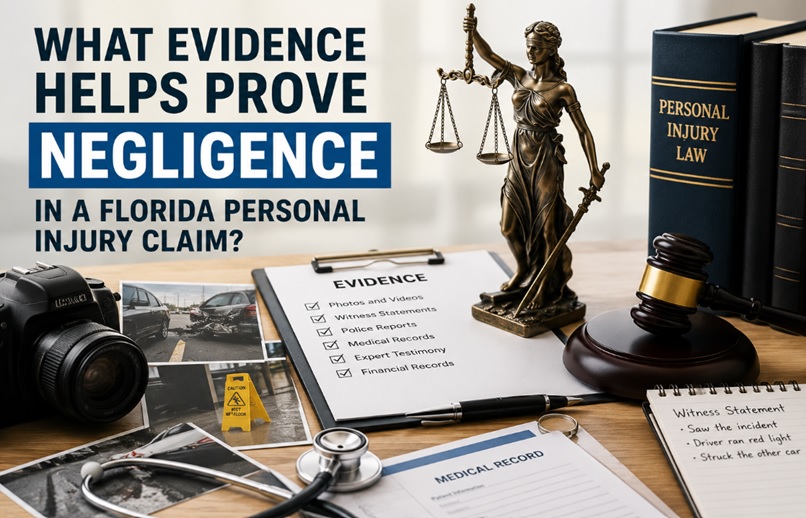
To pursue compensation through a Florida personal injury claim, the injured person generally needs evidence showing that someone acted carelessly and caused the injury. Strong evidence can explain what happened, who was responsible, and how the accident affected the injured person’s life.
Florida negligence claims usually involve four main elements: a duty of care, a breach of that duty, causation, and damages. In simple terms, the injured person must show that the other party had a responsibility to act carefully, failed to do so, and caused measurable harm.
Photos and Videos From the Accident Scene
Photographs and videos are often some of the most helpful forms of evidence.
After a car crash, photos may show vehicle damage, skid marks, traffic signals, road conditions, debris, or poor visibility. In a slip-and-fall case, they could show spilled liquid, broken flooring, missing warning signs, or inadequate lighting.
Photos should be taken as soon as it is safe to do so. Dangerous conditions can be cleaned up, repaired, or changed quickly.
Nearby businesses, homes, vehicles, and public areas may also have surveillance cameras. Dashcam footage or cellphone videos can sometimes show exactly how an accident occurred.
Accident and Incident Reports
Official reports provide a written record of the event.
A police crash report may identify the drivers, passengers, witnesses, vehicle positions, insurance details, and any traffic citations issued. A report from a store, apartment complex, or workplace may document when the accident occurred and when management learned about the dangerous condition.
A report does not always decide who was legally at fault. Still, it can help preserve important details and identify people who may have useful information.
Witness Statements
Independent witnesses can support an injured person’s account of the accident.
A witness may have seen a driver run a red light, noticed that a store employee ignored a spill, or heard someone admit responsibility. Witness testimony may become especially important when the parties disagree about what happened.
Names, phone numbers, and email addresses should be collected when possible. Memories can fade, so early written or recorded statements may help preserve what a witness remembers.
Medical Records
Medical evidence connects the accident to the injuries being claimed.
Emergency room records, diagnostic test results, doctor’s notes, treatment plans, prescriptions, physical therapy records, and specialist reports can document the type and severity of an injury.
These records may also show when symptoms began, whether treatment was consistent, and whether the injury caused lasting limitations.
Delaying medical care can create questions about whether the accident caused the condition. That does not always destroy a claim, but clear and timely documentation can make causation easier to establish.
Expert Testimony
Some cases involve technical issues that cannot be explained by ordinary evidence alone.
An accident reconstruction specialist may analyze vehicle damage, road markings, speed, and impact angles. An engineer may examine a defective staircase or unsafe building condition. A doctor may explain how an injury occurred and whether future treatment will be needed.
Experts can help turn complicated information into understandable evidence.
Proof of Financial and Personal Losses
Proving negligence is only one part of a personal injury claim. The injured person must also provide evidence of damages.
Useful records may include medical bills, pay stubs, tax documents, repair estimates, receipts, employment records, and proof of missed work.
A daily journal can also document pain, sleep problems, mobility limitations, missed family activities, and other ways the injury affected everyday life.
Evidence of Shared Fault
Florida follows a modified comparative-fault system for many negligence cases. Compensation may be reduced according to the injured person’s share of responsibility. A person found more than 50 percent responsible for their own harm generally cannot recover damages under this rule, although medical-negligence actions are treated differently.
Because fault may be disputed, evidence should address the actions of everyone involved.
The strongest personal injury claims are usually built from several forms of evidence rather than one single item. Photos, reports, medical records, witnesses, and expert opinions can work together to show how negligence occurred and what losses followed.
This post was written by a professional at Bonardi & Uzdavinis, LLP. Bonardi & Uzdavinis, LLP is a boutique, full service law firm providing its clients with a wide range of representation. Our primary areas of practice include real estate, probate, personal injury, construction, and commercial litigation. If you are looking for a real estate attorney or brandon personal injury lawyer contact us today for a case evaluation today!
 Intelligences Law Blog